

Searching for Bing: How Microsoft’s search engine has lost its way - meyersgled1974
In 2015, Microsoft's Bing hunt engine achieved something IT had never had before: relevancy. By notching a 20-percent share of U.S. search, accordant to comScore, it managed to impact Google, the brand that was literally synonymous with lookup.
In 2018, it seems equal Bing's unforced to hand some of that success right-hand back. Why? Because, every bit a habitual Bing exploiter, I've noticed a declension in quality.
In the past I've argued that there were four good reasons to switch from Google to Bing. Since then, I've victimized Bing extensively, and it still remains my PC's default search engine. I've sold colleagues on the benefits of Microsoft Rewards. Like anyone else, I've used Bing to hunt news, research for multi-ethnic media posts on Chirrup and elsewhere, research queries and trips, and more. Simply on more and more occasions, I obtain myself typing in Google.com within the lookup block u, then hunting down some tidbit or story that Iknow is there.
To be fair, Microsoft executives state they aren't seeing any deterioration in quality, and attributed much of what I power saw to glitches. (We've updated this story based along Microsoft's responses to our original report.) My examples, which I've catalogued below, too highlight specific examples of Bing's decline—which again, to be fair, stage my own subjective opinion through cherry-picked examples. Look what you think in the examples below.
News search gets forfeited
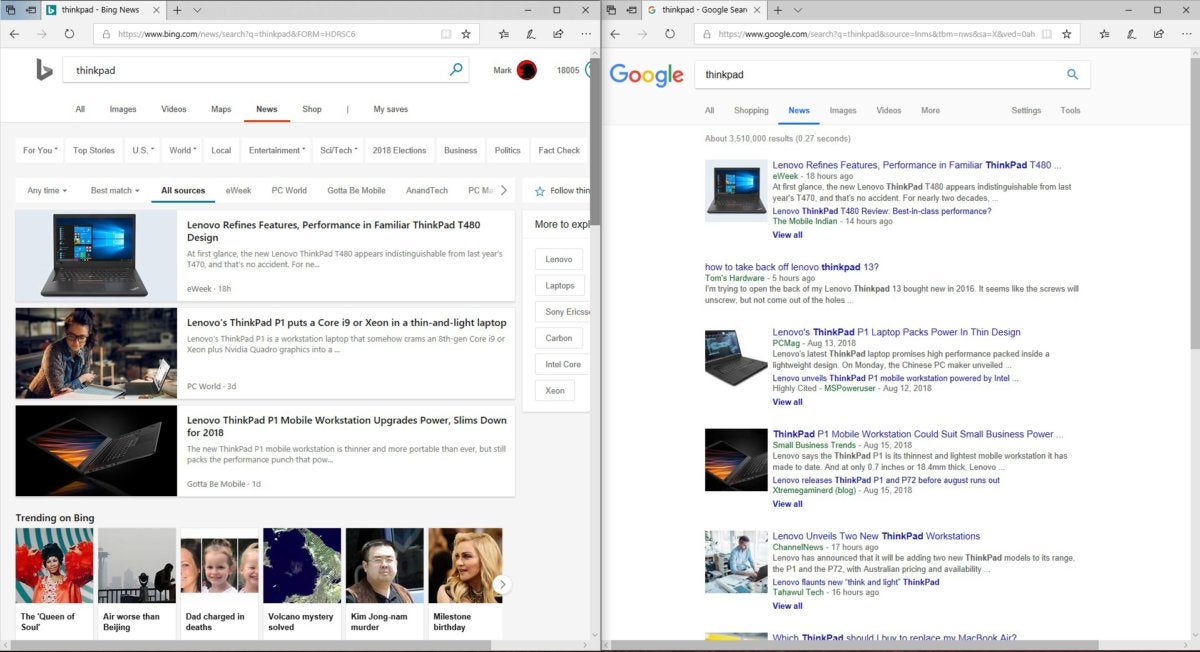
Consider the same search on Bing and Google: "ThinkPad," Lenovo's iconic notebook computer series. As a journalist, I often click along the "news" tab of some search engines, with the idea that I want to construe related news show from both hunting engines, typically referred to as Google News and Bing News.
Straight off thither are stark differences between the two. Bing News shows me evenhanded three results. Non only is IT wasted space, only Google, by comparison, clusters single Recent stories together.
 Mark out Hachman / IDG
 Google is far superior to Bing in terms of information density, as off the beaten track American Samoa news is concerned.
Bing favors the sort of "endlessly scrolling" Web Sri Frederick Handley Page invention that eliminates supernumerary foliate clicks, a show in its privilege. But just three entries retired is a "trending on Bing" carousel with universe news and politics, and nothing about the ThinkPad. That's not what I'm looking for! Google Newsworthiness requires a click to saltation to the next page, but everything appears relevant. When I first started researching this story a few weeks ago, Bing showed me an Battle of Atlanta crime story where a ThinkPad just happened to be united of the items stolen from a vehicle.
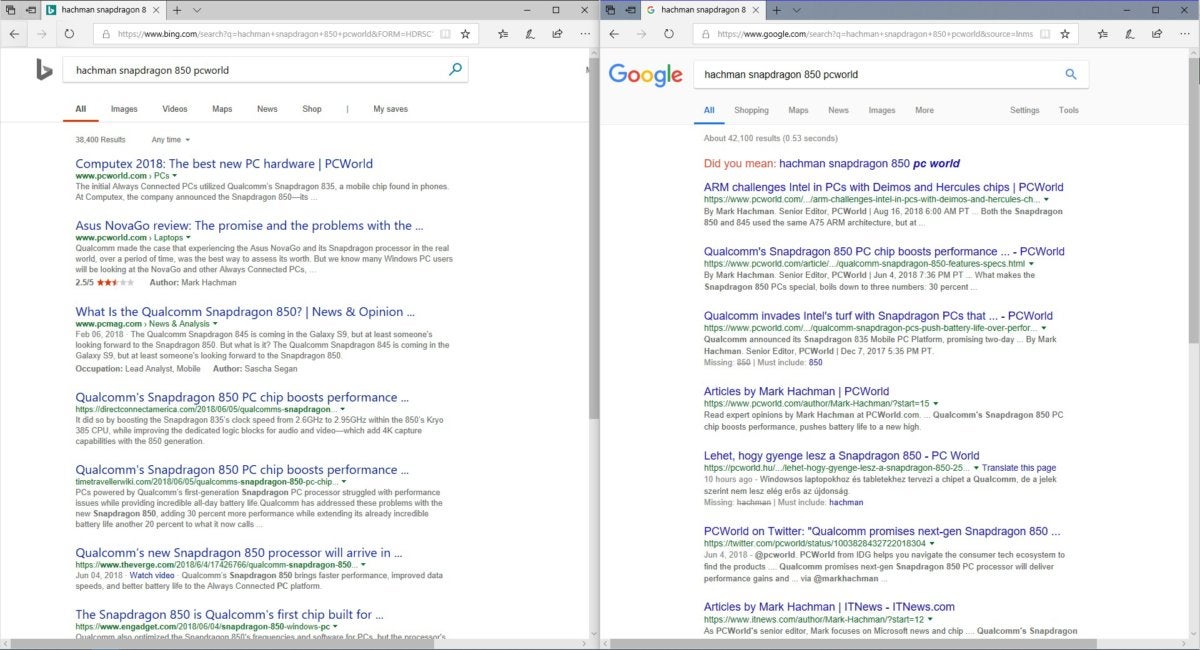
Taxonomic category searches for newsworthiness stories also demonstrate stark differences betwixt the two search engines. I ofttimes use search engines to research (and link) older stories. Entering "hachman snapdragon 850 pcworld" brings prepared the result I'm looking inside Google; in Bing, it doesn't even appear connected the first varlet of results. That's a fundamental stumble, and one I'd swear wasn't there several months agone.
 Mark Hachman / IDG
 For me, this is one of Bing's mountainous weaknesses: my inability to find stories Iknow exist, but prat't find.
Bing seems to atomic number 4 moving in the direction of providing multiple sources or opinions to confirm reports. But from my standpoint, information technology's failing at its basic goal: providing related links.
In response, Jordi Ribas, the corporate frailty president of Bing and AI products at Microsoft, said that the limited "snapdragon" interrogation that I mentioned before was due to a power outage that occurred at one of the company's information centers, and that on that point was an error in merging the document index. Now that Microsoft has fixed the error, Ribas said, the query today returns the awaited result. (It does.)
Microsoft's response: 'independent judges' confirm Bing's success
As part of our conversation, Ribas pushed book binding on my claim that Bing's overall quality had wasted. As start out of the Bing's internal testing process, he said, Microsoft spends millions of dollars on what the caller calls "independent judges," third-company testing agencies that are paid to look at anonymized look results from some Bing and Google. Wholly told, more than 10,000 results are examined per calendar month, Ribas aforementioned, selected randomly from search logs.
Each page is ranked as a win for one position—again, the testers get into't know which is which—or as a tie. Microsoft and so tallies them ahead; a positive score indicates that more pages are being decided in favour of of Bing, and a destructive score shows that the competition, Google, is successful. These metrics show that Microsoft in fact is winning on the order of several points per month dating back to June 16, reported to a graphic that Ribas divided up via a Skype call.
"We've had an addition in market plowshare o'er the years, a 10 percent increase in users," Ribas said, referring to comScore numbers that put the company at about 24 percent of entirely U.S. research traffic. "If anything, we believe that Bing is getting better."
At one stage, Bing touted itself as the destination for sociable search, with a sidebar and varied tools to connect to interpersonal networks. These days it has trouble retention up with Google.
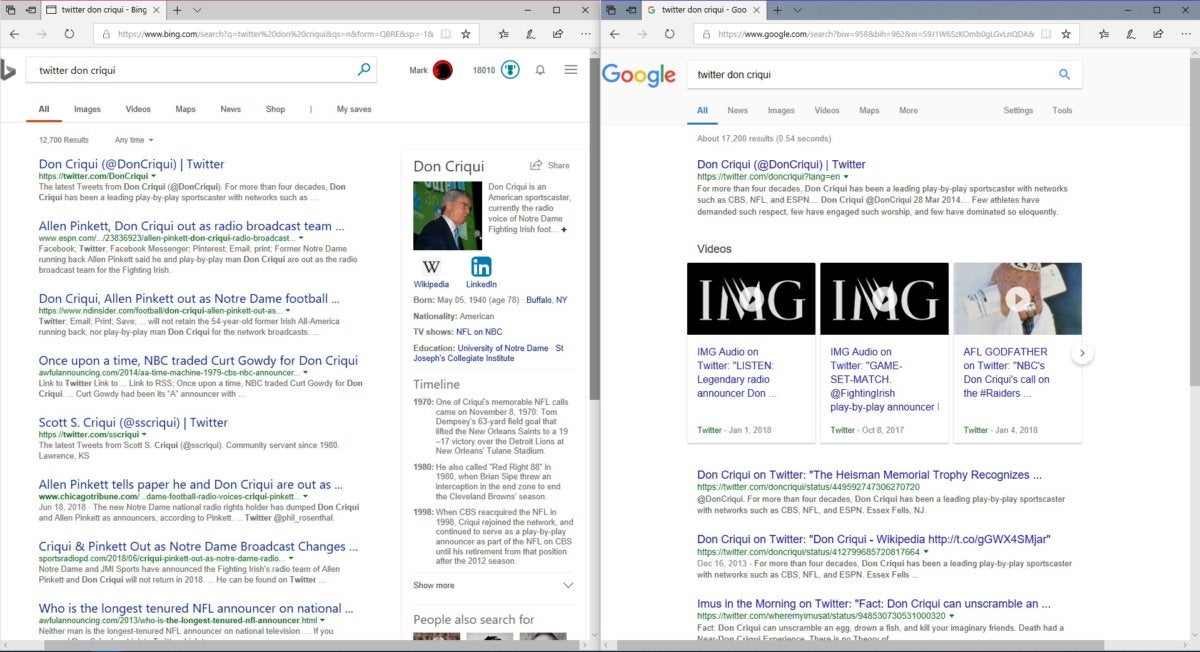
Count the following search, where I wanted to see what the reactions had been to legendary announcer Don Criqui's receiving the ax as the radio voice of my alma mater, University of Notre Dame ("Twitter Don Criqui").
 Mark Hachman / IDG
 Bing offers up some inaccurate results, and generally ignores Twitter search. Google does a wagerer job.
Spell Twitter would like you to believe that the best Twitter search lives on Chitter.com, Bing sort of flubs the complete affair unlikely of the pencil lead result. Google at to the lowest degree gives you a decent attempt. (Unfortunately, neither Bing nor Google rump provide anything besides Criqui's Facebook page.)
Visualize searches are hit-and-drop
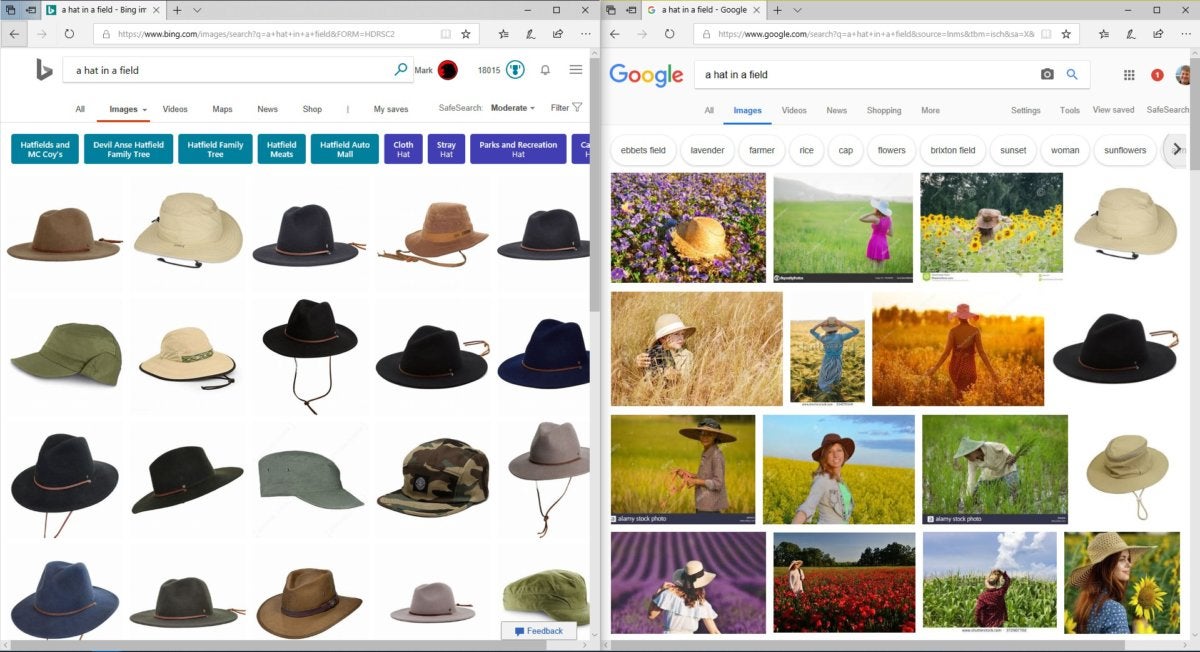
One of the arts strengths of Bing is its image-hunting capabilities, which I revisited to see how the search locomotive engine is doing. It's easy enough to draw up images of actress Nicole Kidman, even when the search is "Nicole Kidman at age 23." (Though does Google perpetrate up more images of a junior Kidman? Perhaps.) But what both Google and Bing are touting today is the intelligence of their search engines: How specific can they embody? Here, Google pulls ahead: try "a snowy lake at night" and "a hat in a branch of knowledg." While some Bing and Google boom the first, Bing fails badly at the ordinal.
 Mark Hachman / IDG
 I'm not sure what's going on here, but Bing's image lookup isn't demonstrating more than intelligence.
Generally, both Bing and Google do fortunate when asked to search for images that you know already exist: "Marilyn President Monro and Groucho Marx," for example, or celebrities generally: "DMX and puppy." Only again, if you're interrogative Bing and Google for images that are (in all probability) being identified by AI, quite than metadata, Google seems to do a better problem. Try associating some random objects together: like "baseball in tree."
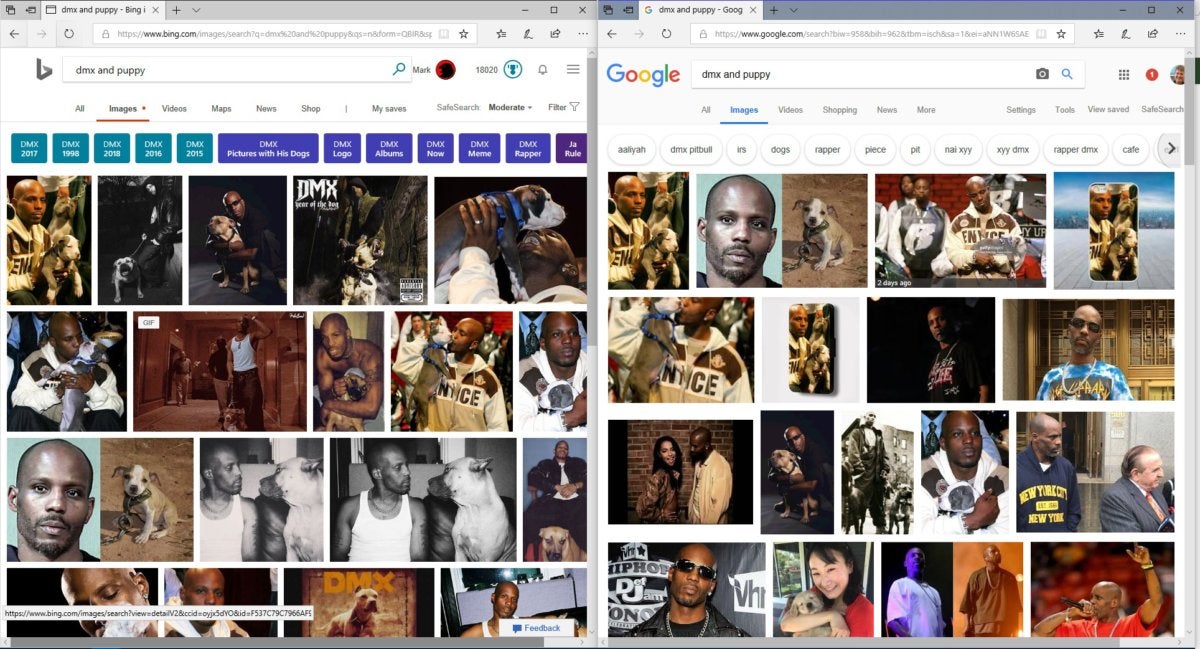 Stigmatise Hachman / IDG
 Not many problems here for either Google or Bing.
For those of you who would never search for something so detailed, that's fine. But for me, I sometimes can't help wondering what I'm missing.
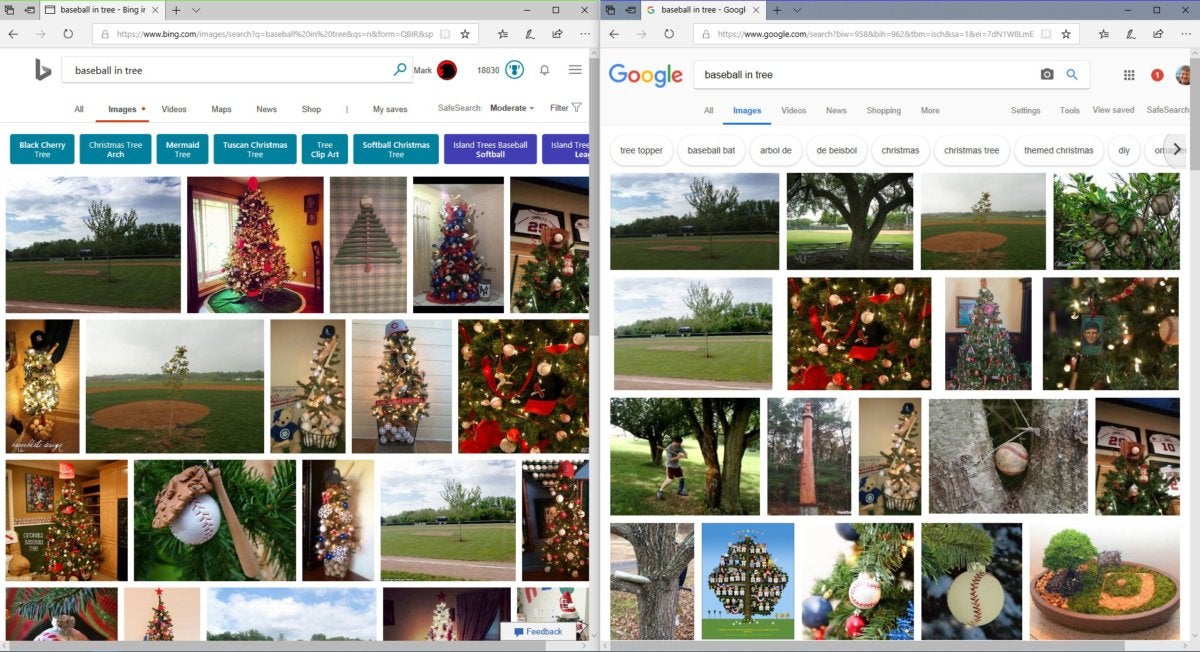 Mark Hachman / IDG
 You may disagree with me, but if I searched for "baseball ornament" I'd expect to see the pictures Bing found. I think Google's results many closely agree the original "baseball in Tree" enquiry.
Here, Ribas showed a few quick examples where Bing did well in displaying "haphazard" combinations of objects in images, such as dogs and cats under a couch. Bing also allows you to lookup within an project, Ribas noted, highlighting a vase, for example, as a distinct object from the coffee table upon which information technology's placed.
Flight data is bogged down by ads
Bing may have recently launched comprehensive services to improve the hotel engagement experience by aggregating 3rd-party data, but the company's basic travel search tranquillise clay underpowered. Take a generic search, "flights to Hawaii."
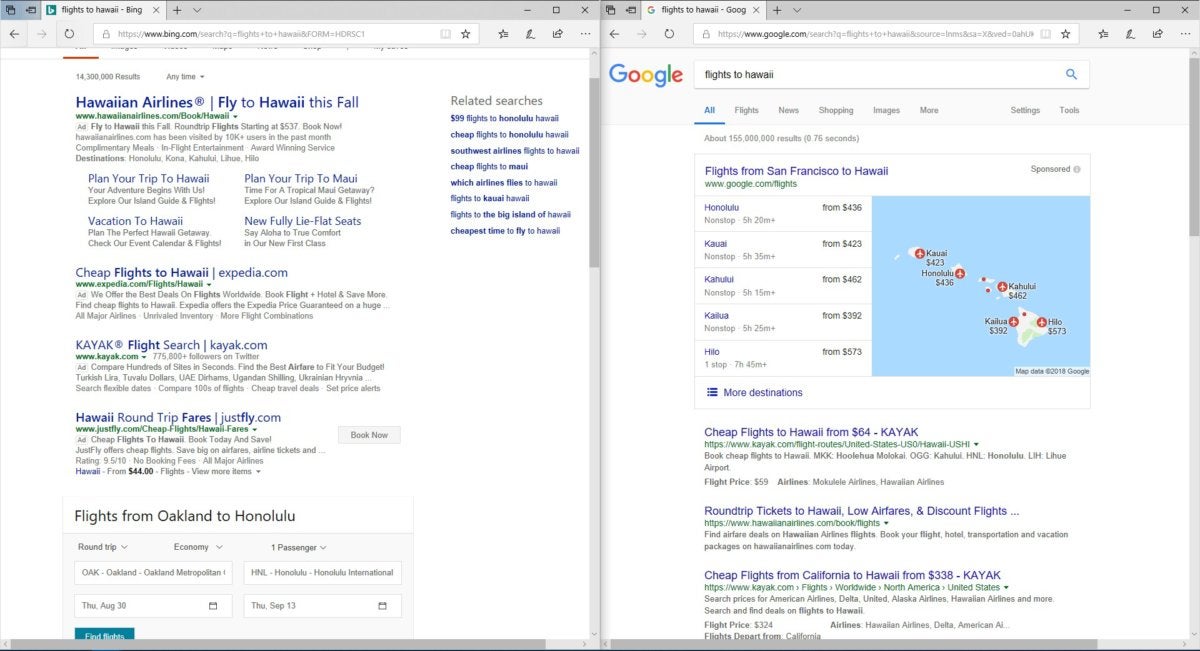 Check off Hachman / IDG
 I've had to scroll pile on Bing's page to get past times the superfluous ads.
You rear end stimulate a constatation, as Bing does, that you'll want to fly into Hawaii's main airport, in Honolulu. Both Bing and Google make your parentage airport via your location, which is fine with me. But Bing does ii things wrong Hera: Extraordinary, it makes you click on a follow-up button to check flight information and fares; and two, it should allow for a tilt or drop-thrown menu of islands or airports. Bing does allow you to select how some passengers you want to bring, withal.
What Bing doesn't rather seem to realize is that information technology's competing with specialty travel search sites similar kayak.com. Google's web site, Google.com/flights, seems to recognize this, and provides a wealthiness of information at your fingertips. On the other hand, Bing intelligently recommends certain flights equally the best for a given set off of criteria, equally per this search for flights to New York City.
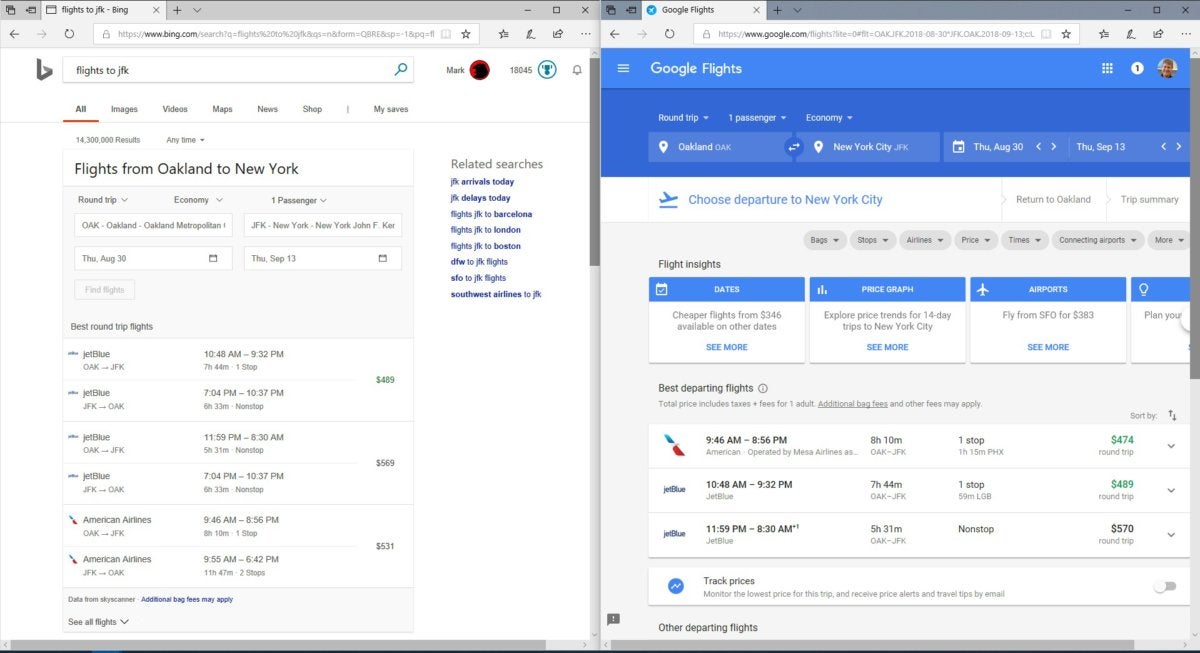 Mark Hachman / IDG
 After request Bing to get flights, or clicking through to Google's flights page, you receive this result. Some search engines mostly fixate the same "best flights," though Google offers far more customization options.
Personalization's benefits are what, exactly?
Another unputdownable component of the "ThinkPad" search within Bing News: The crest results remain timeless, thoughtless of whether I sign into Bing. As a journalist, I let in that personalized results aren't always beneficial. If PCWorld editors are trying to evaluate the relative importance of a particular search term, we look anonymously. This is an anomalousness, however, and information technology goes second to the sometime search riddle: If I'm searching for "Malus pumila," am I looking a Red Delicious, operating room the data processor company? If I'm allowing Bing or Google to enchant my data, shouldn't I benefit?
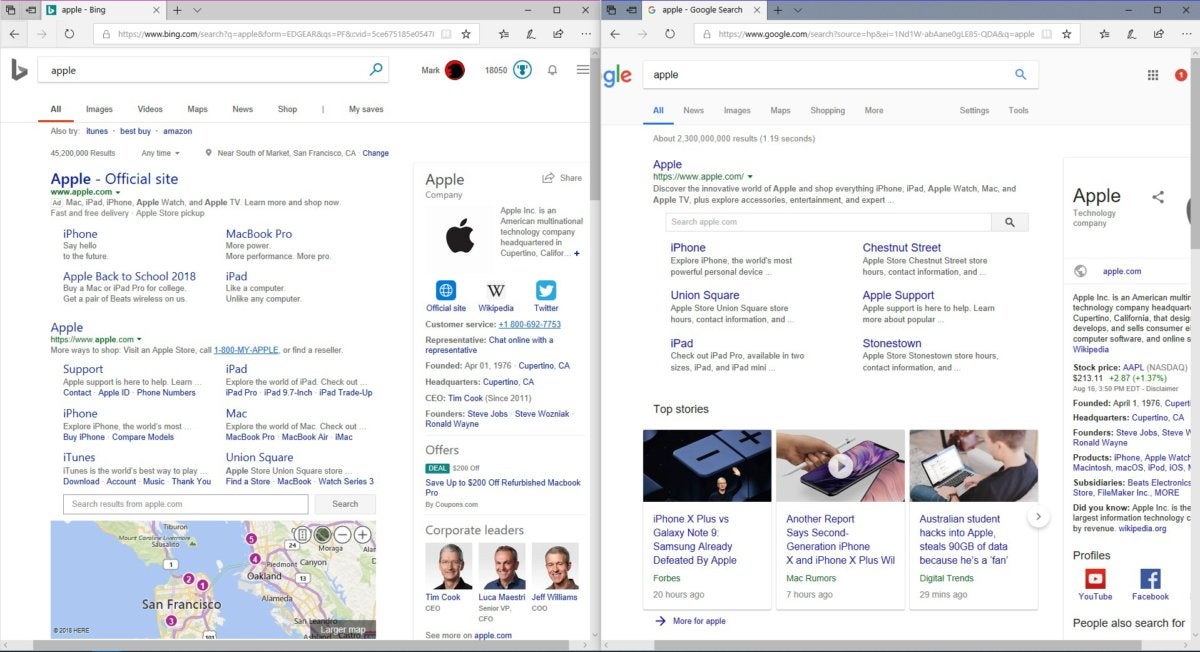
Interestingly, Google seems to give Pine Tree State the same top look results when searching for Orchard apple tree whether logged in, OR faceless. Merely I detected one remainder: When logged into Bing, Bing surfaced several images of apples (the fruit) within its images tab. Google patently knew (Beaver State guessed) that the Malus pumila Inc. logotype was what I was looking for. Some identified Apple Stores near Maine.
 Mark Hachman / IDG
 A explore for "Apple" is pretty neck-and-neck, thanks in part to Bing's strength in comprehensive general search.
Really, this isn't so much of a Bing-vs.-Google issue Eastern Samoa it is just a question of what gain you gain for trading off your privacy. I realize that personalized data is configured to work ads, not search results. But International Relations and Security Network't it clock we got a trifle more out of the deal?
Bing's redemption: answers
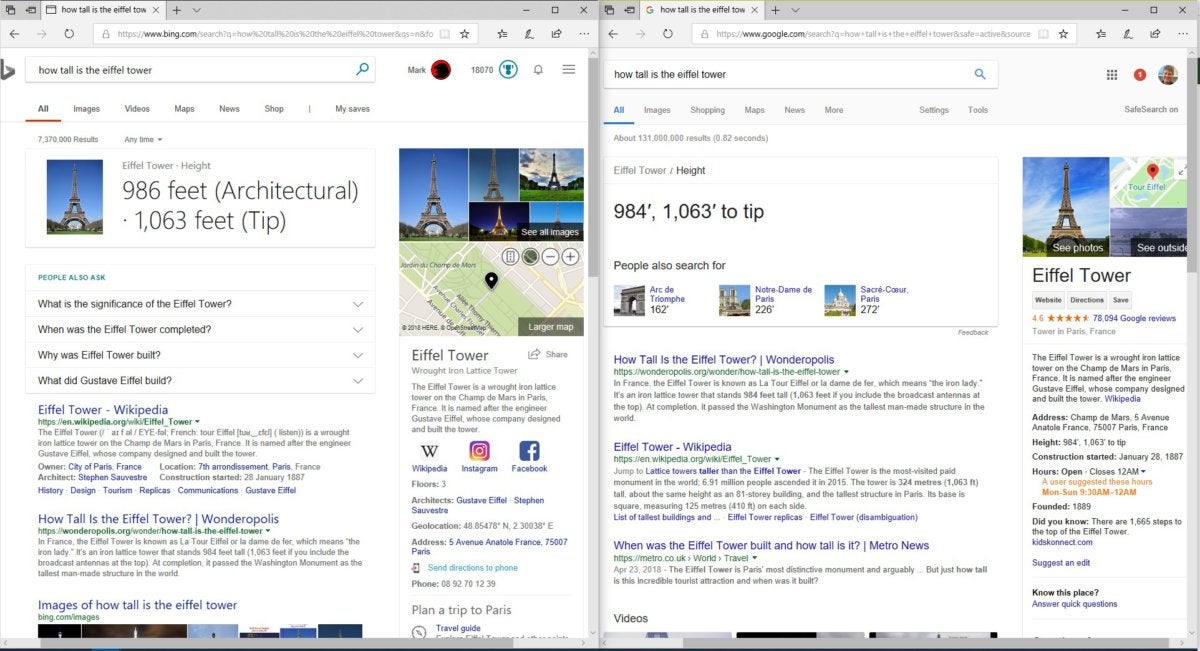
At that place is one look for segment where Bing runs neck-and-neck, operating room even ahead of, Google. When asked a basic question ("how tall is the Eiffel Tower?" "How echt was Abraham Lincoln?"), Bing acts little like a search engine and more like an encyclopaedia, answering the question and then encouraging further exploration via related facts. Google does considerably here, as well. Part of this involves using the sidebar area to the conservative of the chief seek results to provide more information.
 Mark Hachman / IDG
 Bing and Google show basically the same information for a taxonomic group search query like this one.
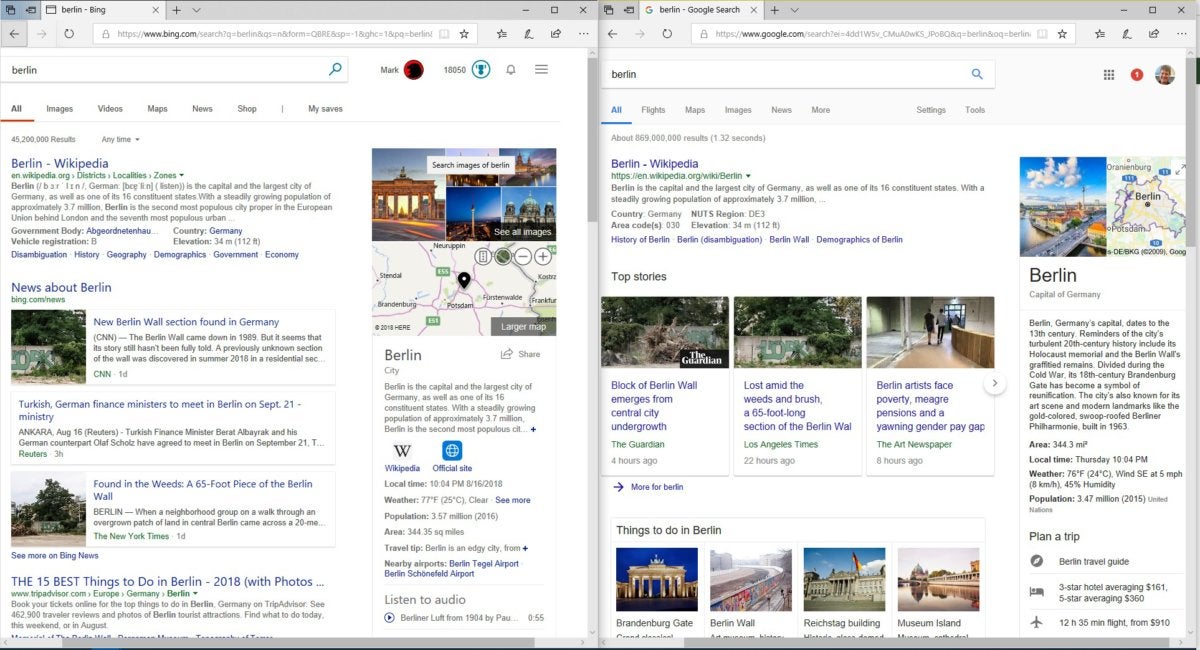
For even an exceedingly generic explore condition ("Berlin") Bing brings awake things to do, facts, images, and news. Google does also, though,and offers to plan a trip. While Bing comes off well in this compare, I think Google goes a little further in providing a user-amiable experience. (Likewise as e-mercantilism opportunities.)
 Mark Hachman / IDG
 I think Google's look (right) for "German capital" is much comprehensive than Bing's (left), but man, those news cards are ugly. (On both panes I've scrolled over to the right to include sidebar information.)
Ribas also pointed out that Microsoft has spent elbow grease in identifying itself in other niches, such A recipes, as well as summarizing e-sports results.
Still, I'd say that Microsoft's direction clearly believes that Bing's road to success lies in this broad middle ground of frequently-searched damage, preferably than in some of the more particular niches that I've highlighted. "Bing IT" may never become a common verb. Just if I'm turning increasingly to Google, I just wonder how numerous another people will cause Google their default search engine—for the first metre in several eld, I'm considering IT myself.
This report has been updated at 12:34 PM on Aug 23 with comments from Jordi Ribas, the corporate frailty president of Bing and AI products at Microsoft.
Source: https://www.pcworld.com/article/402325/searching-for-bing-how-microsofts-search-engine-has-lost-its-way.html
Posted by: meyersgled1974.blogspot.com
0 Response to "Searching for Bing: How Microsoft’s search engine has lost its way - meyersgled1974"
Post a Comment